


RPA vs AI Agents
Traditional RPA is great for repeating clicks. AI Agents are great for making decisions. Understanding this difference is key to ROI.
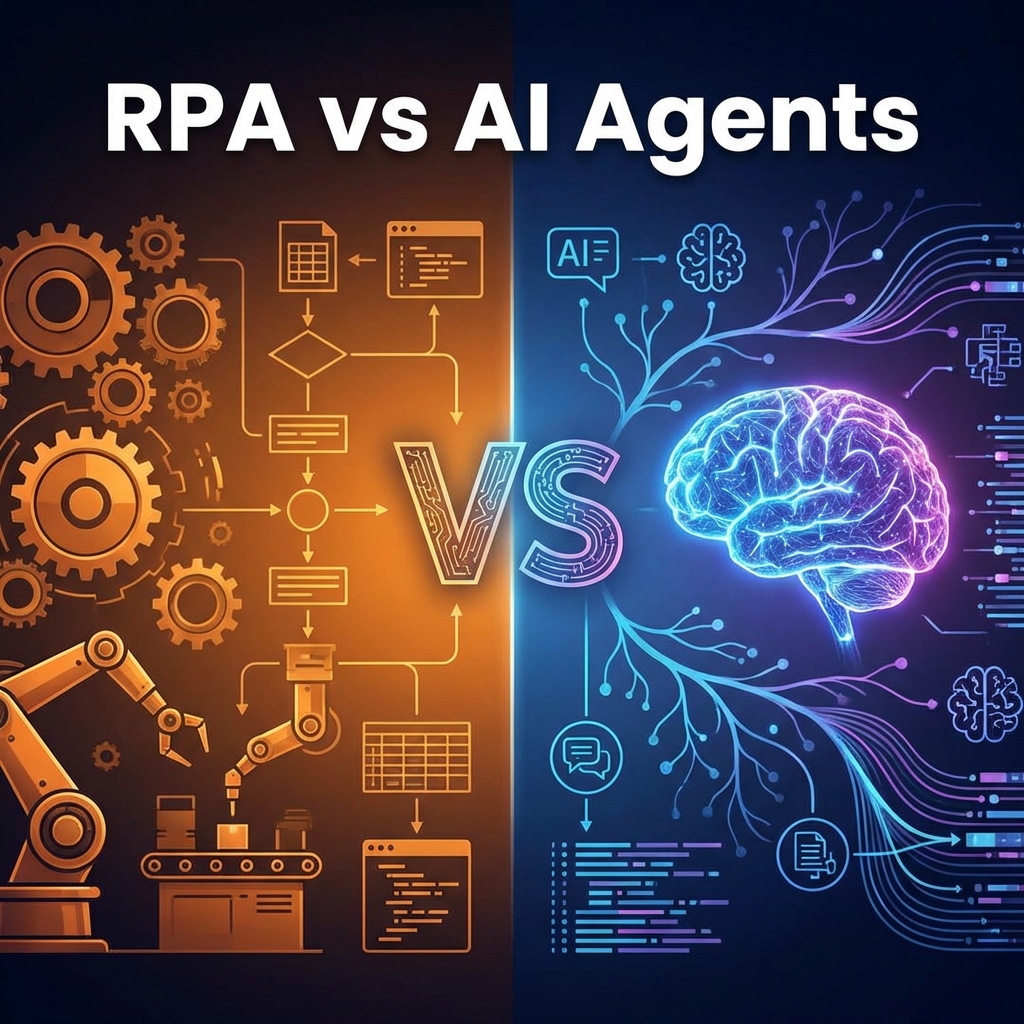
For the last decade, Robotic Process Automation (RPA) was the king of efficiency. “If this, then that.” But what happens when the “that” changes? Or when the input is a messy email instead of a structured CSV?
The Limits of RPA (Robotic Process Automation)
RPA is like a very fast, very obedient intern who cannot think. It follows a script perfectly. If you tell it to click button X, it hits button X. But if the website updates and button X moves three pixels to the right, the RPA fails.
RPA is brittle. It breaks easily. And critically, it cannot handle unstructured data (voice, free-text emails, PDFs with varied layouts).
The Rise of AI Agents
AI Agents, powered by Large Language Models (LLMs) like GPT-4, don’t just follow scripts; they understand goals.
Instead of “Click pixel 400×300”, you tell an AI Agent: “Log into the CRM, find the last invoice for client X, and email it to them.” The Agent figures out the steps. If the login button moves, the Agent looks for the text “Log In” and clicks it anyway.
Decision logic: RPA vs AI
RPA vs AI Agents: At a Glance
| Feature | RPA | AI Agents |
|---|---|---|
| Flexibility | Low (Breaks easily) | High (Adaptive) |
| Data Type | Structured only | Structured & Unstructured |
| Setup Time | Weeks (Scripting) | Days (Prompting) |
| Cost | Fixed License | Per Token/Usage |
Which one should you choose?
Use RPA when:
- The process never changes (e.g., nightly database backup).
- 100% accuracy is required (0% hallucination tolerance).
- You are working with high-volume, repetitive legacy data entry.
Use AI Agents when:
- You need to process customer support emails.
- You need to extract data from varied PDF invoices.
- Decision making is required (e.g., “Is this claim suspicious?”).